Cayman foundation companies for Web3 projects: why, when, and how to set one up
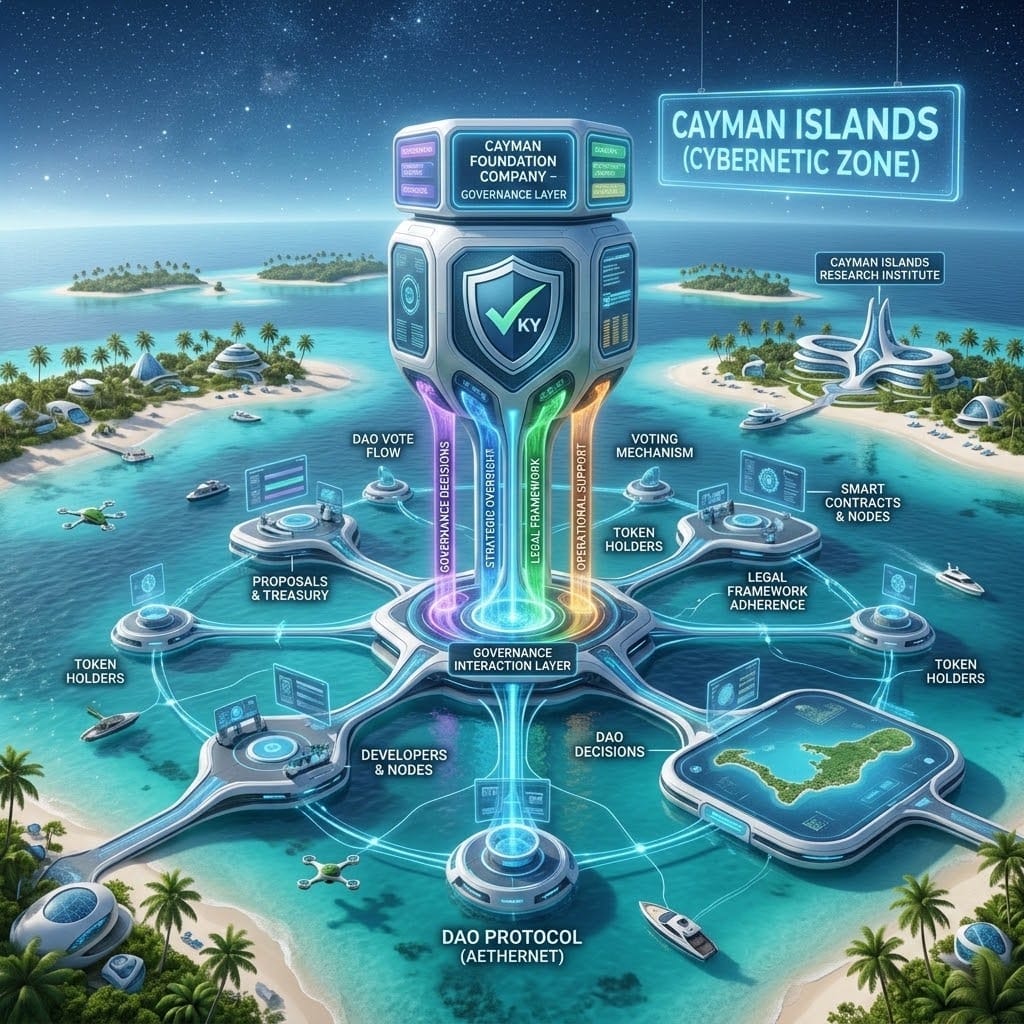
A Cayman Foundation Company is a company that can choose to have no owners. This unusual feature - the ability to become memberless while retaining full legal personality - is why it has become the default legal wrapper for major DeFi protocols, DAOs, and token issuance projects. The Foundation Companies Act 2017 accidentally produced exactly the structure decentralised communities needed: a legal person with no one behind it. This crucial fact means that Cayman foundations are a tool with which to satisfy both ideology (the web3 dream of decentralization), and securities law (the role of decentralization in assessing whether or not tokens are securities)
DAOs like Uniswap, dYdX, Aave others use it, but so do projects with no on-chain voting, no governance token, and no DAO architecture at all - projects that simply need a credible, ownerless legal person to hold assets, sign contracts, steward IP, and engage institutional counterparties without any individual or corporate entity being able to claim ownership of what is fundamentally a community or protocol resource.
The legislators who drafted the Act had civil-law family offices in mind, not blockchain protocols. The FinTech sector found it anyway.
Why this matters now
The core problem the Cayman Foundation solves is structural. Every traditional corporate structure requires an owner - a shareholder, a member, someone with an economic entitlement. That owner is a power centre and a rights-holder. For web3 projects, that creates a contradiction. A protocol governed by a community of token holders, an ecosystem fund deploying grants to developers, an IP-holding entity stewarding open-source software on behalf of its users - none of these should have an owner in the traditional sense. An ownership layer creates exactly the kind of centralised control and/or entitlement that most web3 projects are trying to avoid, and it creates regulatory and governance exposure that the absence of ownership does not. Such ownership challenges the goals of web3 ideology. It also has major implications for securities regulation and tax.
The Cayman Foundation resolves this by allowing the entity to have no owner at all. Directors owe their fiduciary duties to the purposes of the foundation, not to shareholders. There is no one whose economic interests compete with the project's objectives.
Bolstered by a strong legal system, deep web3 expertise, and the international credibility of the Cayman Islands, the Cayman foundation is the most popular DAO and protocol wrapper currently on the market.
Web3 use cases
The Cayman Foundation is not only for DAOs. The absence of ownership is useful across a much broader range of web3 structures.
Protocol foundations: A foundation that holds the protocol's IP, funds development grants, and engages counterparties on behalf of a community - with no on-chain voting and no governance token. The foundation's purposes define the mission, the directors implement it, and the supervisor keeps an eye on the directors.
Ecosystem funds: A foundation holding a treasury of tokens and deploying them as grants or investments under a defined mandate. The investment committee or grant council can be given powers through the bylaws without creating a shareholder whose investment return competes with the ecosystem's interests.
Token issuance structures. A foundation is often used as the entity that receives token sale proceeds and deploys them under a defined purpose - ensuring no individual is deemed to personally own the fundraising proceeds or the mandate to deploy them.
IP holding. Protocol code, trademarks, and brand assets held by a foundation and licensed to operating entities. The IP belongs to the purpose, not to the founders - which protects it from personal creditors, from acquisition without community consent, and from the conflicting interests that arise when individuals hold IP they also develop commercially.
Treasury management. The foundation can be used to separate asset holding from operational activity without creating a shareholder layer. A foundation holds the treasury and an operating company may run the day-to-day business. DAOs often govern treasuries, but they are also seen in other project types.
DAOs. Where community governance through token holder voting, on-chain proposals, and smart contract execution is the primary mechanism. The Cayman Foundation maps onto this because there are no shareholders competing with the community's governance authority, and the bylaws can be drafted to make on-chain votes binding on the directors.
What these use cases share is not governance architecture but a common structural need: a legal person that holds assets and enters contracts for a decentralised or community purpose, without any individual or corporate entity being able to claim those assets or that purpose as their own property.
The structure: roles and documents
A Cayman Foundation Company is an unusual beast. It is a company, but one created so as to have many characteristics of a civil law foundation. It is highly flexible in form and in rules, making it very useful for the diverse purposes to which web3 founders, protocols, and DAOs may put it.
Understanding the roles is essential, because the constitutional design is where the entire structure lives or dies.
Roles within a Cayman foundation
The members: optional
The memberlessness of a Cayman foundation is core to its appeal in web3, but it is commonly misunderstood. A Cayman Foundation must be incorporated with one or more members, exactly like an ordinary company. What makes it different is that it can then cease to have members at any time - and that cessation does not affect its existence, capacity, or powers.
The practical sequence: incorporate with an initial member (typically the founder or a service provider), then pass a resolution to become memberless once the structure is established. The foundation continues to exist and operate as an ownerless entity.
One important constraint: once a Cayman Foundation ceases to have members, it cannot later admit members or issue shares unless its constitution explicitly permits it to do so. If there is any prospect of the foundation needing members in future, that must be drafted in from the start.
Supervisor: mandatory if memberless
If a foundation has no members, it must have at least one supervisor. This is not optional - it is the statutory check that replaces shareholder oversight.
A supervisor has no ownership rights and no economic entitlement in the foundation. Their function is to supervise the board of directors' management of the foundation and enforce its purposes. They can be given wide-ranging powers of oversight and enforcement under the constitution, including the power to remove directors.
A supervisor can be an individual or a committee. A supervisor may also be a director - but this weakens the structure, since the point of the role is independent oversight. In well-designed DAO foundations, the supervisor role is typically held by an elected community council, an independent professional, or a body accountable to token holders.
Directors: fiduciaries to the purpose
Cayman foundations require at least one director. Their role is to manage the foundation and carry out activities that advance its purposes. In a web3 context, this will mean things like executing DAO decisions, or conducting the real-world activities of the protocol. In a memberless foundation, directors owe fiduciary duties to the purposes of the foundation, not to shareholders. On the presumption that they are not directed to break the law - something they will not do - their legal obligation is to uphold and act towards the foundation's purposes.
The constitution can restrict the directors' exercise of their powers to align them with the DAO’s governance. In practice, the bylaws typically provide that directors will implement proposals approved by the DAO's on-chain governance.
Secretary: the requirement people miss
A Cayman Foundation must at all times have a secretary who is a "Qualified Person" - someone licensed under the Cayman Companies Management Act to provide company management services in the Cayman Islands. The secretary's business address is the foundation's registered office, where statutory records must be kept.
This is a mandatory ongoing requirement and a meaningful component of the annual cost. You cannot self-administer a Cayman Foundation.
Founder: optional
Unusually, a Cayman Foundation does not require a founder. Where one exists, the founder can reserve powers under the constitution - to amend the constitution, appoint or remove directors or supervisors, or wind up the foundation. For DAOs seeking bottom-up governance, the founder would not normally retain any powers, making the role nominal or absent entirely.
Beneficiaries: definable by class
A Cayman Foundation can have beneficiaries, or none at all. Critically for DAOs, beneficiaries can be defined by class rather than individually - for example, "the holders of the [Protocol] governance token from time to time."
Beneficiaries have no statutory rights over the foundation, its management, or its assets, and are not "interested persons" under the Act. But the constitution can grant them specific rights, including direct enforceable rights against the directors. This is the mechanism through which token holders are given legal standing.
Core documents: constitution and byelaws
This distinction is structurally important and often overlooked.
The constitution: A core document, public and filed with the Registrar. It sets the entrenched framework: the foundation's name and purposes, whether it is memberless, the existence and basic powers of the supervisor, how beneficiaries are defined (typically by class - "holders of the XYZ token", for intance), amendment and dissolution provisions, and any governance principles the founders want locked in. Changes to the constitution require explicit constitutional permission - what goes in here is difficult to alter later. Most web3 foundations use bespoke drafting rather than the Act's model constitution.
The bylaws: these are not filed and remain entirely private. They operate within the constitutional framework and contain everything the founders want to keep out of the public record: the detailed mechanics of how on-chain governance votes bind the directors, the supervisor's specific powers and appointment process, treasury management protocols, grant-making procedures, and the precise rights of token holders against the directors. Because the bylaws are private, founders can specify exactly how community governance works - including detail that would be sensitive or complex if publicly visible - without it appearing on the register. The bylaws are also generally easier to amend than the constitution, making them the right home for operational detail that may need to evolve as the protocol matures.
In practice, most DAO governance detail - how token holder votes bind the directors, what proposals require what majorities, how the supervisor is appointed - sits in the bylaws, not the constitution. This keeps the operational governance private while the constitutional shell is public.
How this compares to the alternatives
Compared with other DAO and protocol wrapper structures, the Cayman foundation competes based upon the high quality of Cayman law, the strength of the Cayman jurisdiction, and the flexibility of the entity.
Within the DAO world, some projects reject Cayman foundations due to (a) its reliance on the power directors to execute the purposes of the foundation and (b) because token hodlers are not made formally a part of the entity - unlike in MIDAO LLCs and Swiss association.
For DAOs and protocols in particular, the Cayman foundation is currently the dominant legal wrapper - the workhorse of the web3 structuring world.
When to use it, and when not to
Use a Cayman Foundation when:
- The project is or intends to be at significant scale, where major exchanges, custodians, institutional investors, and tier-one law firms are counterparties
- The governance model requires no owner - where a shareholder layer would create a real conflict with community governance
- Securities law positioning means that a token launch must be structured in a decentralized manner
- The treasury or IP is significant enough that the supervisor's enforcement mechanism has practical value
- The project can absorb $18,500+ in formation costs and $10,000–$20,000 annually
Use something else when:
- The project is particularly cost conscious - a Panama PIF provides many of the benefits of a Cayman foundation, at a lower cost
- You are looking for a DAO wrapper with maximum on-chain governance recognition and administrative decentralization. Here, the Marshall Islands DAO LLC may be more structurally aligned
Some regulatory frameworks to bear in mind
Economic Substance Regulations. If the foundation conducts a "relevant activity" - fund management, IP holding as a business, banking, insurance, shipping, distribution, or acting as a headquarters - the Economic Substance Regulations require physical presence in Cayman, local employees, and locally generated revenue. Most protocol foundations whose function is stewardship and grant-making are not conducting relevant activities. But IP management is on the list, and a foundation whose primary role is holding and licensing protocol IP needs this analysed properly rather than assumed away.
The VASP Act. The Virtual Asset (Service Providers) Act applies to entities issuing, custodying, or trading virtual assets as a business. Public token sales require VASP registration; private sales to a limited number of investors may not. A foundation limited to protocol stewardship, grants, and IP holding is unlikely to be directly caught - but a foundation that issues the token itself almost certainly is. This is the main reason the token issuance vehicle is usually a separate BVI or Panama entity rather than the foundation.
UBO reporting. Cayman requires identification and KYC of ultimate beneficial owners - anyone with 25%+ voting power, the ability to appoint or remove a majority of the board, or who otherwise exercises substantial control. In a memberless foundation with no such person, the directors and supervisor are typically treated as the UBOs. They will need to undergo full KYC. For DAOs uncomfortable with core contributors being identified, professional director and supervisor services exist precisely to absorb this.
How to set up a Cayman foundation
Step 1 - Design the governance before drafting anything. Who are the directors? Who is the supervisor, and to whom are they accountable? How do on-chain votes bind the directors? What sits in the public constitution and what sits in the private bylaws? Get this wrong and it is expensive to fix.
Step 2 - consult a lawyer . Governance choices are for the long term. It pays to get them write. Consult a Cayman lawyer to prep your conditional documents and bake your prfferences into the rules of the foundation.
Step 3 - Set up the entity, using a local agent. You will need a local agent to set up the entity and provide you will local services, and this person must be familiar with web3.
Step 4 - Adopt the bylaws. The private governance document. This is where the DAO's actual operating rules live.
Step 5 - Appoint the supervisor and go memberless. Once the structure is established, pass the resolution to cease having members. The supervisor role becomes mandatory from this point. Remember: you cannot readmit members later unless the constitution allows it.
Step 6 - Establish the entity stack. The foundation is rarely alone. Most projects pair it with a BVI or Panama token issuance vehicle and an operating company for employment and commercial contracts. See our token issuance use case page and DAO wrappers use case page.
Step 7 - Annual continuation. Filings, government fees, registered agent fees, and maintaining the secretary arrangement. Miss this and the foundation falls out of good standing.
FAQ
Does a Cayman Foundation have to be memberless? No. It is incorporated with members and can choose to cease having them. Many foundations retain a member - a service provider, a founder entity, or a council - and never go memberless. The memberless structure is what makes the Cayman Foundation attractive for DAOs in particular, but it is an option, not a requirement. The key constraint: once memberless, readmitting members requires explicit constitutional permission drafted in advance.
Can token holders be beneficiaries of a Cayman Foundation? Yes, and this is standard practice. Beneficiaries can be defined by class - "holders of the [Protocol] token from time to time" - without naming individuals. Beneficiaries have no statutory rights, but the constitution and bylaws can grant them enforceable rights against the directors. This is how token holders are given legal standing in the structure.
What exactly does the supervisor do? The supervisor supervises the directors' management of the foundation and enforces its purposes. They have no ownership or economic entitlement. Under the constitution they can be given powers to receive information, review activities, and remove directors. In a memberless foundation the supervisor is the only statutory check on the board - which is why the identity and accountability of the supervisor is the single most important governance design decision.
Can the Cayman Foundation issue the token? It can, but usually it shouldn't. A public token sale would likely require VASP registration with CIMA, bringing the foundation into a licensing regime it otherwise avoids. The standard structure uses a separate BVI or Panama issuance vehicle for the token, with the foundation bound under its constitution to act in the interests of token holders thereafter.
Can a Cayman Foundation distribute profits to members? No. The tax-neutral structure prohibits distributions among members. A foundation is a purpose vehicle, not a profit-distribution vehicle. If profit distribution to token holders is a commercial requirement, a Cayman Foundation is the wrong structure - a Wyoming DAO LLC is the only DAO-specific structure that permits it.
Who gets KYC'd? Anyone with 25%+ voting power, anyone who can appoint or remove a majority of the board, and anyone otherwise exercising substantial control. In a memberless foundation with genuinely distributed governance, this typically means the directors and the supervisor. They undergo full identification and KYC. Professional director and supervisor services exist for projects that need core contributors to remain unidentified.
What does it actually cost? Formation from around $18,500 including legal drafting and the Qualified Person secretary arrangement. Annual continuation — filings, government fees, registered agent, secretary — typically $10,000–$20,000 depending on complexity and whether professional directors and supervisors are engaged. This is roughly four to five times a Panama PIF and is the main reason early-stage projects start elsewhere.
How do I make token holders legally relevant to a Cayman Foundation? Define them as the beneficiary class in the constitution - "holders of the [Protocol] governance token from time to time." This gives them a recognised legal relationship with the foundation without making them members or shareholders. The bylaws then specify what that relationship means in practice: whether they have enforceable rights against the directors, what information they receive, and whether their on-chain votes bind the foundation's management. The beneficiary class definition goes in the public constitution; the rights attached to it go in the private bylaws.
Can on-chain governance votes legally bind the foundation's directors? Yes, if the bylaws are drafted to require it. The standard DAO foundation structure provides in the bylaws that the directors will implement proposals approved by the DAO's on-chain governance mechanism, subject to applicable law and the foundation's purposes. The directors retain the ability - and the legal obligation - to decline to implement a proposal that would violate Cayman law or the foundation's constitutional purposes. This is the correct tension: community governance directs, the directors implement, the supervisor enforces, and the law acts as the outer limit.
Who should be the supervisor in a DAO foundation?The supervisor's accountability structure is the most consequential governance design decision. Options range from an independent professional (most common at early stage), to an elected community council (more decentralised but harder to operate), to a multisig controlled by elected community representatives. The supervisor should not be the same person as a director - independence is the point. For DAOs seeking genuine community control, the bylaws can provide that the supervisor is appointed and removable by token holder vote, making the oversight mechanism ultimately accountable to the community.
Is the Cayman Foundation appropriate for a fully on-chain DAO with no off-chain operations?It depends on what the foundation needs to do. If the DAO genuinely has no need for off-chain legal relationships - no exchanges, no service providers, no IP, no fiat treasury - then the overhead of a Cayman Foundation may be unnecessary. The structure earns its cost when the foundation needs to act in the real world: signing contracts, holding assets in custody accounts, engaging institutional counterparties, or defending and enforcing IP. For a purely on-chain protocol with no external relationships, a lighter wrapper or no wrapper may be appropriate. For anything that touches the traditional financial system, a proper legal entity is the baseline requirement.
What happens to the DAO treasury if the Cayman Foundation is wound up? The dissolution provisions in the constitution specify where assets go. For a DAO foundation, this is typically drafted as: assets pass to a successor foundation with equivalent purposes, or — if none exists — to the community via the DAO's own treasury mechanism. The key design choice is ensuring that no individual can receive foundation assets on dissolution, which would undermine the ownerless rationale of the structure and potentially create tax events in the recipients' home jurisdictions.
Structuring something like this?
Tell us about your protocol, token or fund and we'll recommend the right structure and jurisdiction.
Get started